


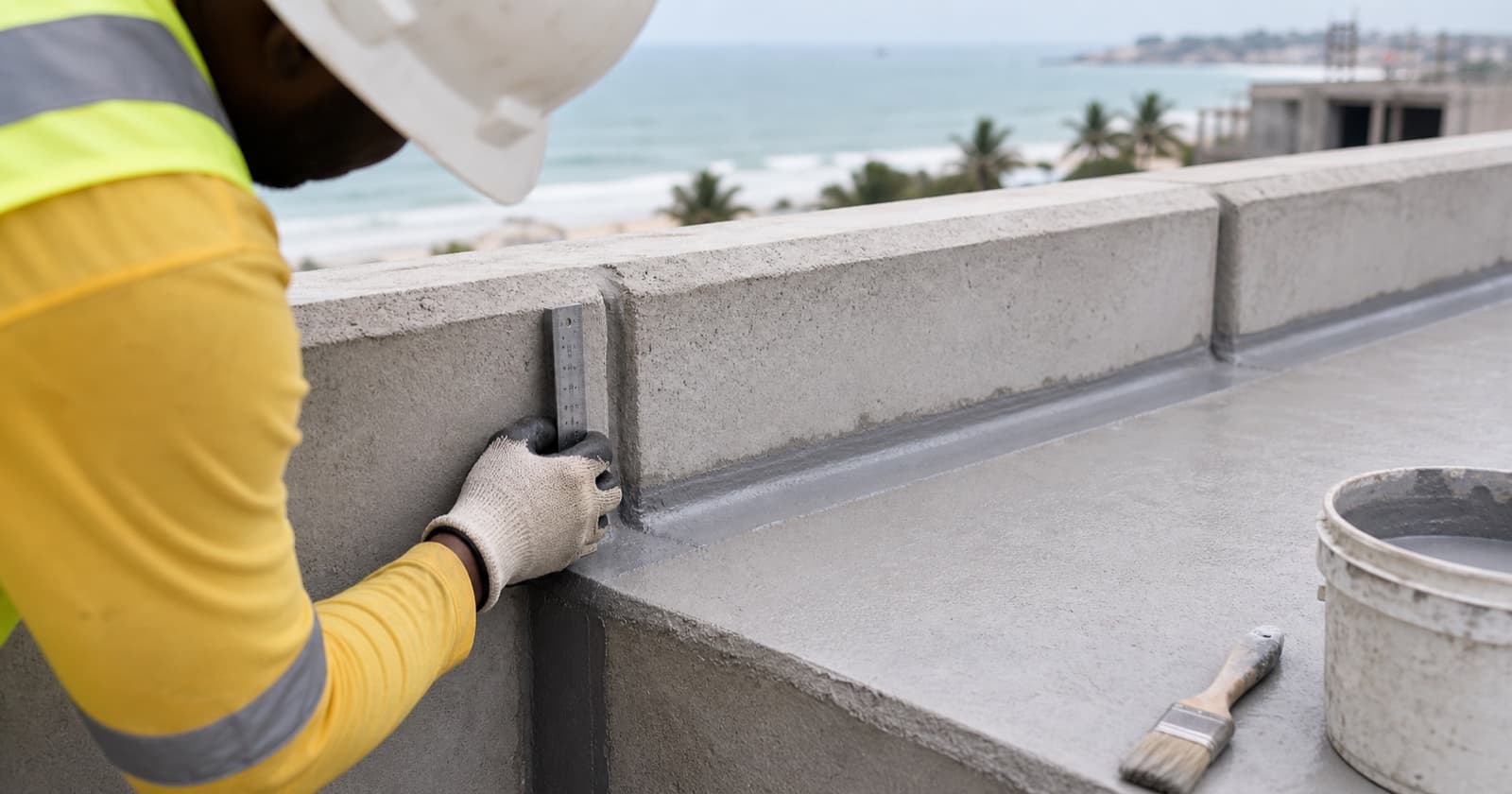
Why Coastal Buildings Leak: A Waterproofing Checklist for West Africa
Waterproofing failures usually begin before the coating is applied. Use this practical checklist to diagnose the exposure, specify a complete system, and control the work.
By Sarakim Trade
Most waterproofing failures are blamed on the product. The real problem often begins earlier: the wrong source of water was diagnosed, a joint was ignored, the substrate was not prepared, or the system arrived without its accessories.
This matters in coastal West Africa, where buildings may face intense rain, humidity, salt-bearing air and strong sun. A roof in Dakar, a basement in Abidjan and a bathroom in Lomé do not need the same solution.
The one rule to remember
Do not ask for “a waterproofing product.” Define the location, water source, substrate, movement and required finish.
That information determines whether the project needs a membrane, cementitious coating, water-repellent treatment, joint system, repair mortar—or several compatible components.
Step 1: Find where the water enters
The visible damp patch may not be the entry point. Before covering it, check:
- Roof falls, drains, overflows and parapets
- Façade cracks, windows, flashings and failed sealants
- Floor-to-wall junctions in wet areas
- Pipes, drains and service penetrations
- Construction and movement joints
- Groundwater and hydrostatic pressure below ground
- Condensation caused by ventilation or temperature differences
A surface coating will not fix a blocked drain or an active structural crack.
Step 2: Match the system to the area
| Area | Questions that matter |
|---|---|
| Roof or terrace | Will it face UV, movement, standing water or foot traffic? |
| Basement | Is there damp soil, occasional water or continuous pressure? |
| Bathroom | Where is the membrane, and how are drains and pipes sealed? |
| Façade | Is water entering through pores, cracks, joints or openings? |
| Water tank | What liquid, pressure and contact approvals apply? |
| Existing concrete | Are cracks moving? Is reinforcement already corroding? |
Technical waterproofing guidance recommends assessing groundwater, drainage, ground conditions and the consequences of leakage before choosing below-ground protection.
Step 3: Buy the complete system
The main coating or membrane is only part of the order. A complete schedule may need:
- Surface preparation and concrete repair
- Primer
- Fillets, tapes, waterstops or joint sealants
- The main membrane or coating
- Reinforcement fabric where specified
- Protection board, screed or final finish
- Compatible material for application repairs
Ask the supplier to identify every excluded component. A cheap quotation can become expensive when essential accessories are missing on site.
Step 4: Compare performance—not product names
Terms such as polyurethane, cementitious, bituminous, crystalline, epoxy and silane describe material families. They do not prove suitability.
Check the properties that affect the actual project:
- Approved substrate and required preparation
- Positive or negative water pressure
- Crack-bridging and joint-movement capacity
- UV, salt, chemical and traffic resistance
- Application temperature and substrate moisture
- Required thickness and realistic coverage
- Curing time before rain, tiling or service
- Compatibility with adhesives, screeds and sealants
Sika notes that sea spray can carry chlorides into coastal concrete. Corrosion may develop before obvious damage appears. In that situation, simply painting the surface may be too late; the concrete and reinforcement may need assessment and repair.
Step 5: Check the delivery—not only the datasheet
Construction chemicals can lose value before they reach the applicator. For imported material, verify:
- Exact product reference and manufacturing origin
- Batch and expiry dates
- Remaining shelf life on arrival
- Storage-temperature limits
- Pack protection inside the container
- Dry, shaded storage at destination
- Safety datasheets and any transport restrictions
A closed shipping container is not temperature controlled. Products sensitive to heat or moisture need a route and storage plan that respects the manufacturer’s limits.
Step 6: Hold the installer to six checkpoints
- Substrate: sound, clean, correctly profiled and within moisture limits
- Details: joints, corners, drains, penetrations and upstands accepted
- Materials: correct reference, batch, condition and expiry
- Application: mixing, coverage, thickness and coat intervals recorded
- Protection: finished work kept safe from following trades
- Testing: visual checks, thickness readings or flood testing completed where appropriate
A small trial area can reveal problems with preparation, coverage and workmanship before the main area begins.
Stop and call a specialist when you see
- Wide, moving or recurring cracks
- Hollow or delaminated concrete
- Rust stains or exposed reinforcement
- Significant leakage under pressure
- Chemical exposure or settlement
- A potable-water, occupied basement or safety-critical structure
These conditions may require a structural engineer, waterproofing designer, corrosion specialist or the manufacturer’s technical team.
Send this information for a useful quote
Provide the city, building area, new-build or repair status, drawings or photos, substrate, approximate area, water source, exposure, required standards and installation date.
Sarakim can coordinate compatible systems and documentation from manufacturers including Fosroc and Sika, then plan packing and delivery around the project schedule. Final selection must be approved for the actual site conditions by the project’s qualified designer and relevant manufacturer.
Technical information checked on 5 August 2026. Always use the current datasheet for the exact product supplied.
Planning a construction materials shipment?
Share your bill of quantities, destination, and timeline. We’ll help you clarify the sourcing and logistics options.
Request a Quote